
After strategic sampling of the water supplies, scientists have concluded that the natural resource contains double the legal amount of radioactive iodine, a deadly cause and major catalyst for thyroid cancer.
Not only did this crisis affect the health structure of Japan, but has also inflicted a low-punch to its economy. According to recent reports, the United States Food and Drug Administration have disseminated information declaring that milk and milk products as well as fruits and vegetable produce from Japan are hazardous, and as a result are to be banned from entering home ports until further notice.
In response to Japan's turmoil, US-based, grassroots philanthropists have orchestrated an effective relief plan titled "Dining out for Japan." This project involves select restaurants based in New York, Portland, San Francisco and Seattle, where consumers can dine and a fraction of the proceeds from the dinners served, will be allocated to the Japanese Tsunami/Earthquake Relief Efforts. For more information and to find out which restaurants are participating visit the following links provided below:
New York
Portland
San Francisco
Seattle

Fewer than half of Americans have had an AIDS test since guidelines were expanded to include routine screening, according to a government report released Tuesday.
Last year, an estimated 45 percent of Americans ages 18 to 64 reported they've had an HIV test at least once in their lives, up from 40 percent in 2006. That's an increase of 11 million people to 83 million people who have ever been screened, the Centers for Disease Control and Prevention reported in Atlanta.
CDC director Dr. Thomas Frieden said the increase was significant and encouraging, while one outside expert called it disappointing.
"The numbers show that progress is possible. They also show how much more progress is needed," Frieden said during a teleconference.
In 2006, the CDC urged routine testing for everyone ages 13 to 64, even if they're not in high-risk groups. For those at high risk, including gay men and intravenous drug users, annual testing is recommended.
Because more people are getting tested, Frieden said, fewer people are being diagnosed late with HIV. In 2007, about a third of infections were discovered late, an improvement from 37 percent diagnosed earlier in the decade. Frieden said those cases are often only detected when the disease has progressed to AIDS.
AIDS drugs lower the amount of virus and are more effective when given earlier. People who know they are infected are more likely to take steps to prevent spreading it, Frieden said.
He said 28 percent of those at high risk have never been tested.
 |
| This information has starkly changed as the percentages have increased since.* |
"If you don't know your HIV status, you can't effectively protect yourself and your partners," he said.
The CDC estimates that about 1.1 million Americans have HIV, but about 20 percent don't know it. About 56,000 new infections occur each year in the U.S.The CDC report was based on nationwide health surveys and state reports on infections.
Dr. John Bartlett of Johns Hopkins University called the testing figures disappointing.
"It's an incremental gain," said Bartlett, an infectious disease specialist.
He said that when the CDC changed its guidelines, many states still had laws that required special counseling before and after HIV tests. Most have since dropped the restrictions, but there are still some barriers. Maryland, for example, still requires doctors to note the patient's consent on charts, he said.
He said more screening could be done if hospitals were pressured to adopt routine HIV testing of patients by Medicare or hospital groups.
___
Online:
CDC report: http://www.cdc.gov/vitalsigns
HIV test: http://www.hivtest.org
AP News Source
 |
| Image Courtesy of Abigail Hayworth |
Again, we introduce to you, a new, yet very ancient cultural practice that is genuinely shocking to the Western Hemisphere, (of that which Life and Style Union resides.) Welcome to Mauritania, a small African locality off the coast of Algeria, whose practices are far more intriguing and buzzworthy than the Lindsay Lohan's jail send-off. Close your eyes, and envision a land of fat, black women - a part from the United States of America, where about 4 out of 5 African American women are overweight or obese. In Mauritania, it's acceptable to fat as it is a sign of beauty, glamour, splendor and rank. What a perfect paradise for us curvy kinds - smiles.
Well, here's the dish...and it is the least appealing, quite frankly. See, in Mauritania, young girls are housed in fat farms and are governed by "fatematous," (fat managers) who over a span of three time periods-morning, afternoon and evening- forcefeed their victims. Girls enter these fat farms at between the ages of 5-7 and are coersed into eating meals of crushed peanuts, blended dates and oily couscous. Water is then given to them by the gallons, and a mandatory "resting" period is enforced, to allow the food to settle. Goat milk which is high in fat and cholesterol, also comprises of the liquid, young girls are forced to drink by the liters.
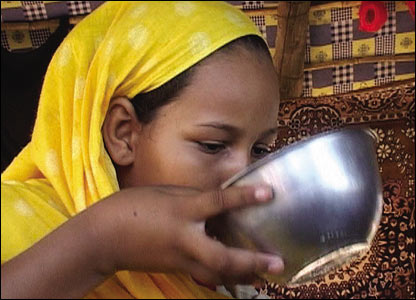
Lejwana, a young girl from Tara, a small region in Mauritania, Africa explains "It sounded like a fairyland. They were going to send me away on vacation from school, and when I came back, it was promised that I will be beautiful." Lejwana, however, later found herself in a smoldering hot hut, deep within the Sub-Sahara, laden with gusts of sandy winds, eating breakfast with five other young girls. Breakfast was not a lightly poached egg with herbs garnishings. It was an unforgiving mixture of chokable, oildrenched couscous with peanuts and watered-down millet.
In a land where marriage and dowery are powered by governmental and economic policy, fat farms still exist and are in no way, extinguishable in the forseeable future. "Men love female flesh in excess" says the fatematou, " the thick, and sweaty layers of fat are not only comforting to potential grooms, but evoke eroticism in Mauritanian culture." Lejwana has approximately three more years to go until she will be auctioned off for marriage. At 16 years of age, she will be more than capable of bearing children. The Fatematou explained that girls who are fattened at an earlier age, like 3-6 years, can bear children when they are ten years old. The earlier the fattening process, the quicker the girl can be married off, the faster the Fatematou gets paid. This capitalist cycle continues day in and day out in Mauritania.
It's the day after Thanksgiving. Reflect on how much food you ate, and how fast you flew to the nearest sofa or bed to rest. Now, imagine this process of eating til' your belly bursts and sleeping, repeated three to four times a day, 365 days a year, for anywhere up to 2-5 years at a time. A true shock, isn't it?

If body odor is a key to romantic attraction, a Florida company claims to have the first scientific way of finding true love.

"Nature attracts us to our genetic matches with our noses. The fact is, we love how other people smell when their immune systems are different from ours—they smell sexier," the company wrote in a release on its Web site.The DNA collection technique will look familiar to viewers of "Law & Order" and "CSI". The company sends sealed cotton swabs and instructs customers to swab the insides of their cheeks.
The company promises to keep the genetic information private by giving its labs only customer numbers, not names.The Boston area could be a fertile market for the service. With its large numbers of college students and recent graduates, 39 percent of the population is single, according to Sperling's Bestplaces.com Web Site.Woman who take birth control pills, use hormonal patches or implants aren't good candidates. The hormones, the company said, leads women to be attracted to different people than those using other forms of contraception.Finding one's soul-mate doesn't come cheap.
The service costs $1,995, which includes the DNA matching and a background check on prospective dates.The company said it will not allow anyone who's been convicted of a sexual offense, a violent crime or an Internet crime to be a member.


It was a fairly recent biological trend to incorporate artificial growth enhancement hormones in agricultural practice throughout the United States and abroad. One such component was the celebrated "chicken pill," a small tablet infused with growth stimulants which expedited the maturation period of chickens, whilst fattening them. Chicken pills have been in sue for approximately 15 years, of course up until it was permanently banned from aproved agricultural customs within America and, in particular, Jamaica, West Indies, as a result of the vain, super-idealistic nature of the aforementioned countries.
The chicken pill gained widespread popularity within the underground community of Jamaica, once its "beautifying" qualities were unveiled. These pills were sold under guise labels like "Gluteus Maxincrease," and "Ms.Big Booty," priced less than a dozen fresh killed farm hens, approximately Five USDs per product. Women throughout the island were content with the low price and guaranteed promise of significant enhancements in the cushion area, (if you know what I mean...) The pills did in fact increase the butt size of women who used the product, however this beauty advantage quickly became overshadowed by its dangerous secondary side effects. In a local West Indian publication, " Dr. Neil Persadsingh, a dermatologist in Kingston, has seen hundreds of young women who have taken chicken pills and have suffered the side effects.
He says it's the arsenic in the chicken pills that stimulates the appetite of the chicken. The government has banned the chicken pill for chickens and women, but it is still available across the island in farm stores and on the street.Some of the side effects include numbness, diarrhea and dermatitis. And arsenic is a cumulative poison that can build up in the body and cause cancer.
What I find amazing is the degree to which women will put themselves at risk to fit an image they consider ideal. - Carolyn Cooper, professor of literary and cultural studies at the University of the West Indies."
Life and Style Union interviews a young, Jamaican girl (whose identity shall remain undisclosed as per her requests) who was courageous enough to share her tumultuous story of when and why she became addicted to chicken pills.
"It's a real ting," begins the young woman, whose Mahogany eyes sink within the mud-paved roads of Portmore. "Lana," is 20 years old, and has experienced, firsthand the pangs of the neverending pursuit of beauty, reflective of Jamaican, cultural ideals.
Lana: So many girls take these pills and are promised to have bigger butts since the men down here claim that they don't want no 'maga' female. 'Maga' means skinny.
Ashleigh: From your understanding, what is the chicken pill?
Lana: The chicken pill or fowl feed, as we call it here in the country, is chicken feed. I don't really know how it makes one's butt bigger, but farmers tell us it works, so we take it. A black market ting, like bleaching.
Ashleigh: When did you begin taking these pills?
Lana: I started taking these pills when I was 17 and the boys were watching us [me and my friends,] saying we were too mal-nourished looking, and true the reggae artists always talk about "fat butts," in their lyrics. So I took them...with my friends.
"They don't want no maga female..."
Ashleigh: Did you find that the pills worked in your favor?
Lana: Well, true I began to eat alot, alot. It's like my appetite went haywire! Pure bammy and ackee I was eating. I started putting on the weight. My butt did grow a lot. But so did my belly- (laughing). Boy I really went through it.
Ashleigh: Did you experience any side effects after taking the pill?
Lana: At first no. Everybody was like "How she put on the weight so fast." I enjoyed the attention. But then, the stomach aches came. I mean some crippling pain. Nightsweats. The whole ordeal. It was crazy. I lost my friend Sonja to it. True, she went to the hospital and never came back out. Doctors said she died from dehydration, or something of similar nature. I don't really know. But her death, caused me to stop cold-turkey.
Ashleigh: That is terrible. It's unfortunate that your friend had to die for the price of beauty. Would you say it was a fair exchange?
Lana: Of course not! I think this experience has truely made me realize that I have to appreciate myself for who I am, and what I look like. I was so eager to change myself, it's like I became a chicken pill addict. I took them like vitamins. I could have died. Just like Sonja. Nothing could bring her back. Too too sad.
Ashleigh: Lana, I thank you so much for sharing your story with me and the Life and Style Union audience. You've really helped in shedding some light on this issue. Thank you.
Lana: Thank you, it was my pleasure.
This leaves one to reflect on the impediments a people would fall vulnerable to, in efforts to attain perceptual "beauty." What's your take?